
YOUR FAVORITE BOOTH — I have never understood why some people use the term “hole in the wall” as something derogatory.
It seems almost every place that has been described as a hole in the wall has either the best food, the best music, the best beer, or some combination of the three.
In fact, the sketchier and un-updated the outside of the place, the better the food is on the inside—usually. If the place still has the neon sign from the 1960s still in force, buddy, you may have hit the jackpot.
A perfect example of this is the old Sam’s BBQ in Montgomery, Alabama. Absolutely nothing about the place screamed fine dining. But for a time, and despite the silly al.com March Madness BBQ contest that had them LOSE TO A CHAIN RESTAURANT in 2013, it had the absolute best pulled pork in the state of Alabama. It was a small, mid-century building just off of the Atlanta Highway. Standard paver/brick floor that you see in most buildings from the era, big windows letting in a ton of natural light in an otherwise dark building, and pictures of friends and family lining the walls. It is the standard for what a barbecue joint should be. Their tagline? “Nothin’ fancy, just great barbecue.” Amen.
It doesn’t just pertain to barbecue, either. Two blocks down the street from Sam’s is The Green Papaya, or in other words, the best Thai place you’ve never heard of.
It resides in the same shopping center as the world’s greatest flea market and antique store, Eastbrook, a post office, and a grocery store. If you didn’t know what to look for, you’d never find it. And you would be missing out. No frills, just a few decorations, a cozy dining room and the best Pad Prik King you’ll ever eat.
Speaking of Thai, The Chicken Shack in Wetumpka, Alabama may be the smallest footprint of a restaurant I’ve ever seen. A literal wedge, it was once a—you guessed it—fried chicken destination, but now is home to the Rice Box Thai eatery.
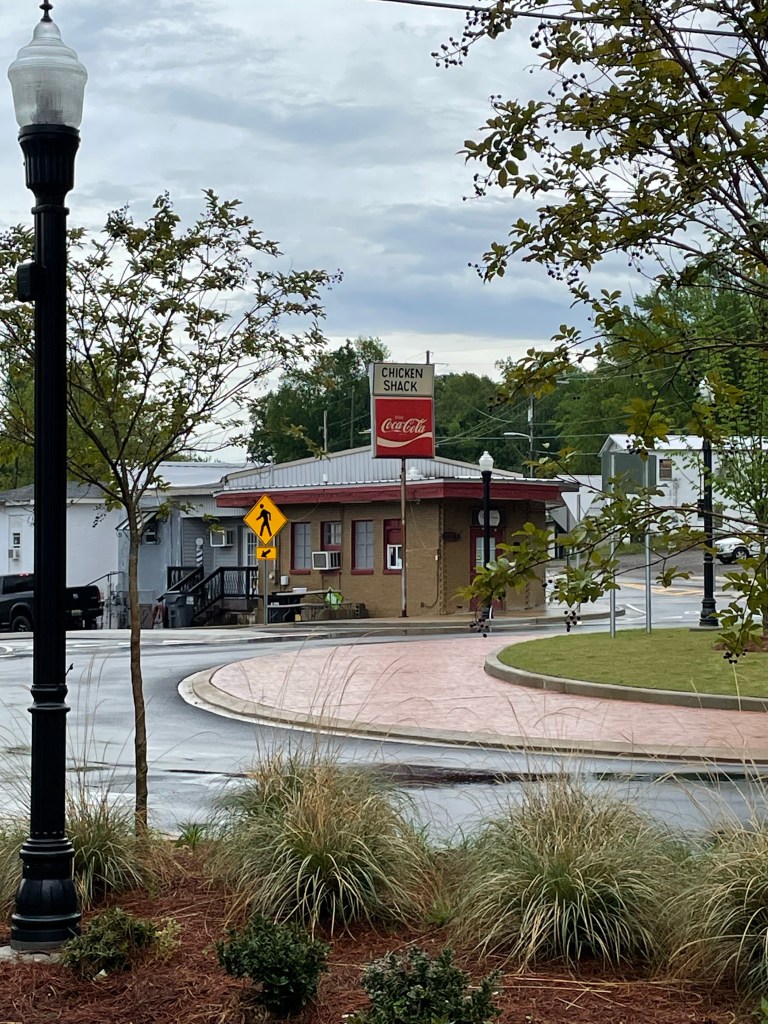
Some places try to appear like a hole in the wall. You can usually find them in brand-new strip malls, or taking the space occupied by former community food staples after those close because the owners’ kids don’t want to do it anymore. They put tacky-chic decor on the walls, add a few semi-sassy quotes behind the counter like “We won’t tell your mama ours is better,” and such like that. But you can’t fake being a true hole in the wall. You have to earn that.
You can’t fake being in the same former gas station, wood smokeshack, or mid-modern building for five decades. You can’t fake the yellowing pictures on the walls of famous patrons or family timelines through the years. You can’t fake aging but timeless neon signs, or the same soft drink-sponsored letter-groove menu that have been up since stock cars were actually stock.
And you cannot fake the same time-tested recipes that have been handed down over multiple generations.
In fact, I’d argue what’s worse than a faux-hole in the wall, is a hole in the wall that has died.
Back in my reporter days, I had the fortune to cover such a funeral. In 2011, I was an intern for the Clanton Advertiser, a small-town paper in the heart of Alabama. We got word that the Dari-Delite North was closing.
The Dari-Delite was one of the first things I noticed about Clanton; you would drive through the main thoroughfare in town, U.S. 31, and at the top of a hill about a quarter mile from the Advertiser office was a building that looked like 1950 dropped a restaurant off and left it. It was a tiny building, with a clean coat of white paint and dark blue roof. On the roof, however, was the icing on the cake.
A mid-modern neon sign with “Dari-Delite” lit up like a beacon to the hungry and nostalgic, bordered by an ice cream cone, an arrow pointing to the restaurant and a chicken in a top hat. Iron oxide was starting to set it on the sign, but that only added to the charm.
Glorious.
It really was a time capsule. The lobby was big enough to walk in an order, and there were picnic tables out back to eat under the shade of tall pine trees and watch trains roll by on the long tracks behind the restaurant.
I interviewed the owner, Ruth Mims-Short, at the time of closing. She was an incredibly sweet woman, and legitimately teared up during the interview. She said the age of the building–and her own age–led to the decision. But you could tell it was incredibly difficult for her.
And before you get on your high horse and laugh at the outlandishness of a woman crying about a fast food joint closing, put your saddle up. It wasn’t that a fast food joint was closing; it was that an institution was closing. Serving Broaster chicken to thousands of people for decades allows you to build relationships, to become part of peoples’ lives and you theirs.
Most telling of this was the story Ms. Mims-Short relayed to me during our interview. Apparently, an older couple stopped one summer day and asked who the manager was. Instead of reprimand, the couple informed the manager that they lived up north, but were from Clanton and went to school there.
And on one particular night, the couple said, the man proposed to the woman at one of those tables under the shade of a pine tree. She said yes, naturally, and their journey together began there in that parking lot.
Those are the kind of memories that holes in the wall hold. Decades of patrons. Thousands of stories. Modest presentation, amazing food. Sadly, not only is the Dari-Delite North gone, the building was torn down some time in the last few years. I wish I knew where that sign was. It belongs in a museum.
Not bad for an old hole in the wall.

 The Kudzu